Contact our expert
Nils Jänig
Operation Line Director
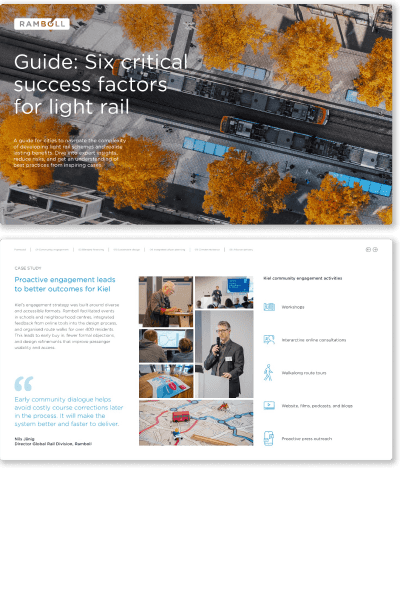
As interest in light rail grows, Ramboll has published a new quick guide that provides six practical best practices and case studies for ensuring the smooth delivery and operations of LRT schemes.
Light rail is now a central part of urban mobility strategies in more than 400 cities worldwide[1]. It offers high-capacity transport, supports compact urban development, and helps cities reduce emissions while improving liveability for residents.
Evidence from across Europe and North America shows that property values and rents often increase near light rail corridors[2]. For cities facing pressure on land use, climate targets, and inclusive growth, light rail is a proven solution.
Over 400 cities worldwide are reaping the transformative benefits of light rail[1]
What defines success in light rail projects?
Successful light rail schemes do two things well:
- Deliver effectively: on time, on budget, and safely
- Perform in operation: achieving strong ridership, reliability, and long-term financial sustainability
Underperformance in these areas often stems from early decisions around governance, corridor selection, and funding. Guidance from organisations such as the World Bank and US Federal Transit Administration highlights the same risks: insufficient early planning, unclear responsibilities, and inadequate funding and operating models.
The following six success factors address these risks directly.
1. Engage with the community early to ensure LRT truly serves local needs
Projects that engage with communities too little or too late are more likely to face local resistance, delays, and costly redesign. Without early input, light rail schemes risk missing local priorities and creating solutions that do not fully serve users.
To ensure community involvement genuinely shapes the delivery of light rail projects, it is essential to define several key decisions early and before routes have been fixed. Plan a thorough stakeholder mapping and a clear engagement strategy to reach diverse groups. Combine this with a mix of accessible engagement formats is used including workshops, digital tools, and local events.
Establish clear governance to handle feedback and objections, so that community input is systematically gathered and reflected in design development. By making these decisions upfront, project teams foster open dialogue, minimise resistance, and ensure the light rail scheme truly serves local needs.
KPIs to measure the effectiveness of community engagement:
- High rates of participation in engagement activities
- Limited formal objections during planning
- Evidence of design changes based on community input
2. Secure funding that is resilient to political and market changes
Bringing light rail projects from the drawing board to reality requires high upfront costs. The long term viability of LRT schemes depend on a good funding strategy that spreads risks and is resilient to political shifts and market changes.
Blended financing combines national support, EU-funded grants, contributions from local authorities, and innovative tools like land value capture. This approach helps ensure long-term viability and spreads risk across multiple funding sources. Early definition of fare policy and operating model based on revenue assumptions and cost baselines can help to avoid budget overruns.
How to tell you are on track:
- Funding secured across all project phases
- Realistic cost forecasts
- Alignment between capital investment and operating model
Connecting communities. Transforming cities.
3. Design for lifecycle performance and sustainability
Light rail projects are often assessed on upfront capital cost, yet much of their long-term value is determined by how they perform over decades of operation. Without a strong focus on sustainability across design, delivery, and operation, LRT systems can face higher lifecycle costs, lower efficiency, and missed opportunities to deliver wider social and environmental benefits.
Sustainability measures on light rail schemes include lean and efficient structural design that reduces material use, specification of durable and low-maintenance materials for resilient rail infrastructure, and implementation of energy-efficient systems including overhead electrification and optimised depot design.
Light rail can also contribute to social sustainability by improving inclusivity and liveability. To maximise these benefits, cities and operators should aim for an accessible light rail network that ensures step-free access and improves connectivity for underserved communities.
How to assess the success of sustainability efforts on your project:
- Measurable reductions in material use and embodied carbon in construction
- Lower energy consumption during operations
- Improved accessibility and connectivity for users
- Positive liveability impacts such as reduced stormwater runoff
4. Integrate light rail with the wider city and transport network
Light rail systems that are poorly integrated into the cityscape often fail to achieve expected ridership. Even well-delivered infrastructure can underperform if it does not connect smoothly with other transport modes or align with how people travel.
Effective integration requires early collaboration with planners, developers, and transport agencies. Corridor selection should be based on demand and aligned with housing, employment, and urban regeneration plans.
Higher ridership rates are more likely to be achieved if the light rail system has good links with bus, cycling, and walking networks and if a common fares and ticketing system is in place across public transport modes.
All these different factors allow the light rail project to become a catalyst for growth and optimised land use.
How to evaluate the effectiveness of LRT integration:
- Ridership meets or exceeds forecasts
- Increased modal shift from private vehicles
- Evidence of development and investment around stations
5. Build resilience into design and operations
Climate risks such as flooding and extreme heat are increasing and can disrupt light rail operations. Systems that are not designed for future conditions may face higher maintenance costs and reduced reliability.
Climate risk assessments should be conducted in the early planning phase to inform design decisions. In addition, flood and heat mitigation strategies need to be aligned with city-wide resilience plans for maximum impact.
Use of nature-based solutions such as green track beds helps to reduce stormwater run off and contribute to urban cooling in contrast to asphalt surfaces.
Finally, detailed plans for continuity and recovery should be drawn up to minimise any disruptions once operations commence.
Measuring resilience in the project:
- Reliable service during extreme weather events
- Reduced disruption and faster recovery times
- Compliance with resilience and sustainability targets
6. Establish strong governance and collaborative delivery
Unclear governance and accountability are common causes of delay and cost overruns. Alliance contracting unites all key parties into a single team with shared rewards and risks, which helps reduce delays and disputes while fostering collaboration and innovation.
The Alliance delivery model establishes clearly defined roles and responsibilities whilst also improving decision-making processes. It also allows for proactive management of interfaces such as utilities and permits.
Some key indicators to evaluate the effectiveness of your delivery model:
- Timely and effective decision-making
- Reduced disputes
- Delivery aligned with programme and budget
Frequently asked questions
Get the new guide on light rail success factors
Ramboll expertise